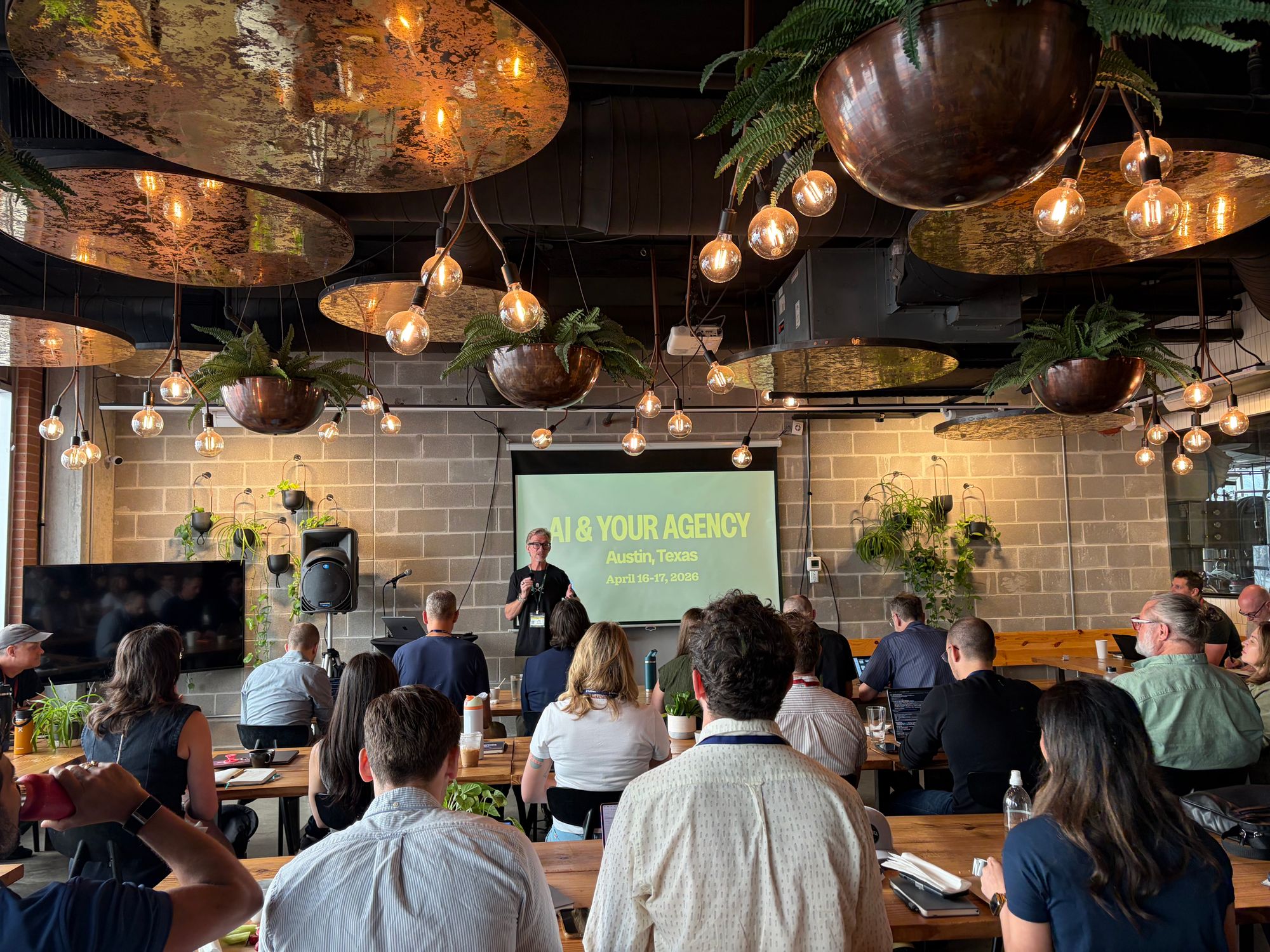
I went to AI & Your Agency in Austin expecting to come home with a list of tools, prompts, and maybe a few new workflows we could try at SmartLogic.
I did come home with those, but the bigger takeaway was not about tools at all.
The real question is not: “How do we use AI to move faster?”
The better question is: “Which parts of our workflow need to change now that AI can participate in the work?”
That distinction matters a lot.
If we just use AI to speed up the same old process, we may get marginally more efficient. But we will probably also create new review burdens, new quality risks, and new confusion for our teams and clients.
That theme showed up again and again throughout the conference: AI adoption is not primarily a technology problem. It is a leadership, operations, and judgment problem.
That aligns with what we’re seeing in custom software work, too.
How AI Strategy Changes the Role of Software Teams
One idea that got my gears turning was this: people contribute more when they help design better work, not just when they can get it done quickly. This is especially true for software development teams.
A developer’s value is not just writing code. A project manager’s value is not just moving tickets around. A delivery lead’s value is not just keeping everyone updated.
The real value is knowing what matters, asking better questions, setting up the right context, designing the right process, validating the output, and owning the outcome.
AI can help produce a first draft of a project plan. It can help summarize status. It can help generate tests. It can help explore implementation paths. But it does not own the client relationship. It does not understand the nuance of a founder’s urgency. It does not know when a “technically correct” answer is still the wrong answer for the business.
That is still human work.
And for the kinds of companies we work best with — funded SaaS startups in public health and health tech that need to move quickly, make smart product decisions, and use data well — that human judgment matters even more.
Speed is valuable. But only if it is pointed in the right direction.
Why AI Adoption Fails Without Leadership and Direction
Another theme that hit me hard was the gap between leadership enthusiasm and team adoption.
A lot of leaders are experimenting with AI. They are prompting, testing tools, building little workflows, and seeing possibilities everywhere.
But that does not automatically translate to the rest of the team.
Teams need two things: direction and permission.
Direction means they know what leadership believes about AI, how it fits into the work, and what is expected of them.
Permission means they feel safe enough to try things, fail at things, and bring ideas forward before they are perfect.
That second part is easy to underestimate.
People are not always resisting AI because they are anti-technology. Sometimes they are scared. Sometimes they do not know where AI is acceptable. Sometimes they are worried that if they save time, the value will only accrue to the company and not to them. Sometimes they do not want to be judged for producing something weird while they are still learning.
So leadership's job is not just “buy the tools." They need to create the conditions where experimentation is safe, visible, and useful.
One practical idea I liked was the “10-minute rule”: before starting a task, spend 10 minutes thinking about how AI could help accelerate it. Then stop and do the work.
That is small enough to be realistic. It does not require a full transformation program. It builds the habit of asking, “Could this be done differently?” without turning every task into an endless tooling rabbit hole.
Agentic Coding is Real, But It’s Not Magic
The agentic coding sessions were exciting, but not in a “developers are done” way.
The message I heard was more nuanced: execution may compress, but planning expands.
One speaker described agentic coding as requiring much more upfront planning and documentation, sometimes thousands of lines of requirements and context. The coding itself can happen much faster, but the work does not disappear. It moves.
Humans become responsible for defining the architecture, breaking work into phases, creating the context documents, setting up validation, reviewing the output, and making sure the system is solving the right problem.
That is a very different mental model from “AI writes code now.”
It is closer to managing and improving code-writing systems.
We recently explored similar ideas in our SmartChats conversation about AI in software development, including how tools like Cursor, Claude Code, and GitHub Copilot are changing engineering workflows and reshaping how teams approach delivery.
For a custom software company, that is a big shift. It means our processes need to become more explicit. Our requirements need to be sharper. Our testing practices need to be stronger. Our documentation needs to be more for humans and the AI systems helping us do the work.
That part feels especially important.
If AI performs poorly, the right question may not be, “Did AI fail?”
It may be, “Did we fail to give it the context it needed?”
What Successful AI Strategy Actually Requires
I left Austin more convinced that AI will change how software gets planned, built, managed, sold, and supported.
But I am also more convinced that the winners will not be the teams chasing every new tool.
The winners will be the teams that redesign how they work.
They will be the teams that build shared AI capability instead of treating AI as one person’s side project. They will be the teams that protect human accountability while using AI to improve speed, clarity, and decision-making. They will be the teams that document their judgment, not just their tasks.
For SmartLogic, that means the work ahead is practical.
We need to keep experimenting. We need to build safe internal workflows. We need to clarify our AI policies. We need to improve how we capture context from sales through delivery.
And we need to keep the order right:
People first. Process second. Technology third.
That may sound less exciting than “agents everywhere.”
But it is probably the only way agents actually become useful.
FAQ
What is AI adoption?
AI adoption is the integration of AI tools into day-to-day business operations and workflows. Successful AI adoption often requires teams to rethink how work is planned, reviewed, and delivered.
What is agentic coding?
Agentic coding uses autonomous AI systems that can write, edit, and test code with minimal prompting. Human developers still oversee architecture, validation, and strategic decision-making.
How are AI tools changing software development work?
AI tools like GitHub Copilot, Cursor, and Claude Code help engineering teams automate repetitive tasks and accelerate delivery. As a result, engineering roles are shifting more toward planning, systems thinking, validation, and workflow design.
Thinking Through AI Adoption in Your Organization?
AI tools alone won’t solve operational bottlenecks or unclear workflows. Successful AI adoption requires thoughtful systems design, strong engineering practices, and a clear implementation strategy.
SmartLogic partners with organizations to build scalable software, improve operational workflows, and thoughtfully integrate emerging technologies into real-world delivery processes.
Interested in exploring what that could look like for your team? Schedule a free strategy call and let's talk about it!